Thursday, 9 October 2014

Jenga - revisited


A couple of people have asked me recently about using Jenga as a learning resource, and because I have an impossible amount of marking to do tonight, what better way to sidetrack than to write my blog!

The last post about Jenga was on my Posterous (RIP) blog, so unavailable. And as it is, I have since developed and increased the usage of the resource.

Primarily for me, Jenga is a great resource for encouraging spontaneous speech, for encouraging team work and reinforcing vocab.

How to start?

Option 1:
  • Label all the bricks 1-6 (If you have more than one set, mark all the bricks in each pack with a colour, so that if bricks go astray, you know where they belong!)
  • Consider 6 questions you want the students to spend time working on, orally, so that each time they take a brick out of the tower, they have to respond to that question in as much detail as possible. This is very good CA preparation.
  • The aim for the students should be to give more information every time they answer the same question. Because I only have 8 in that group I let them choose who they played with.
  • Establish the ground rules from the start - wait for the person to give their answer before playing on. The boys want to destroy the tower but not lose, so they just ignore the one giving the answer
  • Consider the groupings. 2-3 students, and experiment with same and mixed ability

Option 2:

  • Label the bricks 1-48
  • Type up a grid of 48 questions and corresponding answers
  • Each time a brick is removed, they have to translate/answer the phrase/question that corresponds to that number on the sheet.
  • Consider having a quizmaster/scorer for this. You can also have a Group Talk score sheet, as I have mentioned before.

Lots of varieties - feel free to share your version!

Thursday, 18 September 2014

TickBoxTastic


I have blogged a-plenty about lots of different ideas for delivery and reinforcement, engagement and planning.

So I have started using something archaic - pen and paper - to keep an overview on tasks I have done with each class.

I have a spreadsheet with lots of different activities listed on it, and all my classes. Each time I do one of the activity types listed, I put the date in the relevant box. That way, I know I am doing a range of activities, and also that the lessons aren't stale or predictable.

Back to basics. I didn't say it was revolutionary.


Sunday, 29 June 2014

Using Technology to Engage - CPD session

 
As part of our NQT/New Teacher programme at school, CPD sessions are run, which are also open to all staff, as the themes of the sessions are based on the CPD needs/requests of the staff. I was asked to deliver a session on Using Technology to Engage, which meant I was able to release my not-so-inner geek.
 
Unfortunately, the session was at the end of Ofsted Day 2, but I still had ten keen colleagues attending.
 
Below is a summary of the ideas delivered, and they can be used, regardless of subject area.
 
* gif moving images
 

We all love to jazz up our resources with pictures, cartoons and the like (surely this comes second to visiting stationery shops?). .gifs are a more engaging version, and there are thousands upon thousands available, and you will always find one that is relevant to your topic.
.gifs are tiny snippets of video real, 1-2 seconds long, that just repeat on a loop. They are good to have on the board as the students walk in, especially if it triggers prediction, thought, hypothesising, questioning etc. There are some very entertaining .gis available that can be used purely as a hook as the students walk in, or to link task to task to maintain engagement. Examples given were:
PE - could use a clip of a skill or muscle-action as a hook.
Science - could have a clip of a particular reaction to discuss/predict/hypothesise.
History - a snippet of an era/important moment relevant to what is being taught.
 
I often use Tumblr, but a colleague at the session also pointed out that you can access a lot on Google images, with an advanced search.
 
* Quizlet and Kahoot


These websites are a great way to deliver vocabulary, facts, key words, and I am sure that readers of this blog will be able to suggest different ways that they use it. What I find very frustrating with the current cohort (which seems not to be specific to our school) is that students don't know how to learn. Because of the here-and-now, instant world that they live in, if they don't get something within 1-2 times of practising, they will simply give up. 
So to have websites that support the learning process is a step forward to our students increasing their motivation for independent learning. 
The website addresses are Quizlet and Kahoot - have a play, look for quizzes already available for your subject area, and then get creating!
 
* Linoit
 
When I first started at my current employ, homework was very rarely done, as it had very rarely been set/marked/monitored. So my quest was to find homework tasks that engaged the students, and made them want to do their homework, and to then to have pride in it. We are still finding ways to achieve that with a positive hit rate, but LinoIt really helped to engage the students.
For those unaware of how it works, students create post-its on a canvas. Pictures, documents and links can be uploaded on there, so it can be used as a resource bank as well for any particular task. You can also add feedback post-its as well, as you can see in the picture above. My username is mflcostello (outdated by name), so sign up and have a look at how it can be used.  
  
*QR Codes

I didn't go into too much detail about QR Codes, partly because nobody was able to get an internet signal in my room, but also because our use of mobiles (or lack of) in school restricts the amount we can use QR codes on a daily basis. But the potential of QR codes is huge, and we use them on our displays, as students have their mobiles with them before and after school, so are able to zap any QR codes.
If any of the MFLTwitterati has written a blog where QR Codes are mentioned, or knows of one, please leave a website link in the comments box at the end of this blog.
 
* Subtitles
This idea may seem MFL-specific, but it isn't! When we use video clips or DVDs in target language (French/German/Spanish), students are often put off, firstly because "it's all in foreign" and secondly because the subtitles "move too fast". So to introduce them to the notion of watching the subtitles and not so much the picture, I play Subtitle Bingo. We played this at my session at #ililc4, so some members of the MFLTwitterati will be familiar with this. 
It is very easy to prep. You watch a 2minute clip with the subtitles on, and note down as many words as you can. (For non-MFL subjects, this may be longer!). You then use the words to create a number of bingo cards. Print off, distribute, and then play the clip with subtitles twice. It is a great way to train the students to watch the subtitles, but is also great to practise word-recognition (hello, literacy tick-box!)...
 
* Subtitling YouTube Videos
This session is best described in my blog from #ililc4, when I learnt all about creating your own subtitles. It is a great way of posting key words, questions, tasks on a YouTube video, so the students can watch the video and carry out tasks, without having to continually look at a sheet. The uses in any subject area are plentiful.
 
* Visualisers
 
 
I wasn't in a position to show the visualiser in action, because I had forgotten to install my visualiser on to my school laptop (I blame Ofsted entirely). But colleagues at the session were entirely in agreement on its merits. DT use them, Music could see that showing a piece of music played on a keyboard from above had huge advantages... @TeacherToolkit has recently blogged a great piece about them      
 
These are just a selection of ways of using technology to engage - if you have any you would like to add, please do, either in the comments below or on Twitter with a crafty link, if you have it on a blog. I can then add them to my blog to help colleagues develop and increase their repertoire.


Tuesday, 10 June 2014

Progress in a revision lesson. Discuss.


Observations wait for no man. My last formal observation was the day after I lost Scout. Today's observation was following a no-sleep weekend after Nightrider. Which is why making sure your lessons rely heavily on student-led tasks is crucial.

Today I was observed with my challenging yet small year 9 group. To put the situation into perspective, we have Exam Week next week, with all year groups sitting end-of-year exams in most subjects. The week commencing June 30th sees the start of the new school year and our timetable rollover. So we are delivering a lot of revision lessons to our classes in KS3, and really pushing y9 French students to Levels 5 and 6.

So my lesson today looked like this:
The main purpose of the tasks today was to increase the confidence of students when they come across longer texts, as many of them still look at a Level 5/6 text and reverse away from it. (I find myself doing the same with very long emails, so I know how they feel!).

So the first couple of quick-fire tasks served to remind the students of the patterns and importance of "é" and "ai" in tenses, which we had spent some of last lesson really getting on top of.

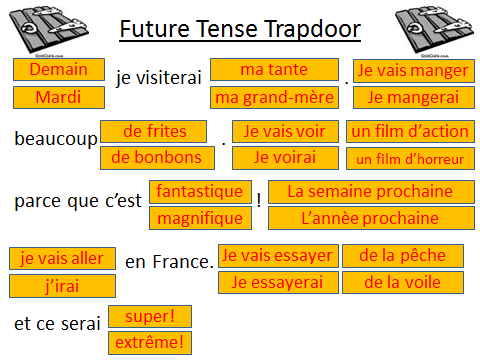
The group is small, their team work is sometimes questionable, but two tasks they love are Cluedo and Trapdoor. So we were working on them when the observers arrived. (It is too late to spot the spelling mistake!!!!!!!)


Next up was the team work element of the lesson, to pull key info out of the given texts. I used question styles from the exam papers, so they are used to the style. It was also the chance to use my differentiation by colour.


Students were put into 3 groups, which had one student of each ability group (set by target level). The task was a running dictation, and each group had the same task sheet. On that task sheet was a differentiated task by colour. 
Students had to work together and help each other. They were also encouraged to use their key-word sheets which they have been given to help revision. The texts were scattered around the room, and it was the most active they have been as a group in a running dictation. One of my "green" girls (target level 4a) was picking out key words left, right and centre, which was great to see.

So... the outcome of the observation?

Things I had to overcome in the lesson:
  • I didn't have my full quota of students until 20minutes in, because of assembly over-running and some students being held back for a roasting over uniform. Which meant they arrived in a less then positive frame of mind
  • One student was outside waiting to be removed by on call when the observers arrived
  • Two (normally very reliable and focused) girls refused to take part in the whole class game of Cluedo, because of the two other teachers in the room.
On the positive side of things, the participation in the group games of Cluedo and Trapdoor was great, and once the students had started the running dictation, I was delighted with their levels of understanding. I was disappointed then when the observers left after just under 20mins, because they didn't see the task in full flow. 

The lesson was deemed to be Good. It wasn't awarded Outstanding because they couldn't work out how much progress was being made. We did a plenary at the end to recap the patterns, examples and time phrases for the past and future tenses. In retrospect I should have made it really clear (even clearer) how vital nailing the tenses are for levels 5 and 6.

So my question to you all is... How can you quantify/measure confidence and reinforcing to prove to non-specialist onlookers that the students can perform better at the end of the lesson than they could at the start?

I'll be darned if I know right now. I shall give myself time to ponder.   

In the meantime, let us turn to Sophie.

Monday, 9 June 2014

Nightrider 2014


My annual nocturnal adventure around London did not disappoint. Well, it sort of did, because it was the same weekend as our hockey club's annual festival, which is always brilliant fun. But Nightrider was on the same weekend as it always is, and our festival had changed dates a couple of times. There was no way that I was missing out on the bike ride I have come to love. So, I went to the Friday night bash, played 4 games of hockey on Saturday, and then went tally-ho to London Town.

This was Nightrider #4 for Gemma and me, and this time we had two new team mates - Burrows and Shiney - which made the adventure even better. Happy in the knowledge that we had raised over £1000 for Spinal Research before we started, we were really looking forward to it. Especially as the weather had been so awful for most of the week, and the skies had cleared ready for the ride.

This year we started at Crystal Palace for the first time, instead of Alexandra Palace, and I think I preferred it. Our start time was 11.15pm, and we didn't have much waiting around, which meant our timings for the evening were perfect.


The first part of the ride was quite frustrating as we headed into town. It was very stop-start with so many traffic lights to get caught up in. I looked at my Garmin watch to check the mileage, and we had gone 12 miles in 1h30 because of so many red lights. But the camaraderie with all those around us was excellent, making it much more fun.

The first stop was Tower Bridge, which came upon us without warning! We normally hit this point at sunrise when we start from Alexandra Palace. But this time it was stunning...


We then twisted and turned our way around the west side of central London, seeing the Tower of London, The Strand and Canary Wharf, before we headed out towards the Olympic Village. Greenwich is always good to cycle around, and as we sped through the flat town we chatted to fellow riders.

I didn't go to the Olympic Village in 2012, and now, having cycled round it, I regret it. I could imagine how amazing the atmosphere felt. It was fitting that our 2nd stop was right outside the Velodrome. A great setting to refuel amongst so many cyclists.  


It was amazing, on a warm night, how quickly our temperature dropped, and we were glad to set off again when we did, as we were all beginning to cool off. We headed off through Hackney and Haringey - interestingly enough, on the map it shows no place of interest in that stretch! I don't remember seeing any, but that's perhaps because I was bracing myself for the Ally Pally hill! Last year I cycled all the way up, but had a stop half way up. This year the bollards half way up were my target, and I used them this year as well. Gemma cycled beside me to encourage me up, and I said to her that I would stop at the bollards and then cycle again. She set off, so she didn't lose momentum. I reached the bollards and carried on, and made my way to the top without stopping - which I was so proud of, as this was the first time! My breathing was very laboured at the top, but nothing that ventolin couldn't resolve!

We warned the others about the hills after the epic descent from Ally Pally, but I had forgotten (or my brain had shut out) the 3 hills... I only remembered 2! Lordy! But again, I didn't stop on any of the hills, and just kept pedalling!

The most bonkers sight of the night goes to Picadilly at 4.30am. It was absolutely heaving. It was congested, with many very impatient car drivers, tooting and honking unnecessarily! Once we were beyond the official photographer, the roads were much emptier. Again, it was great to chat to cyclists around us, while we waited patiently for our turn to move on through the traffic.

The most breathtaking view of the ride was on Waterloo Bridge, as the sun was coming up. Almost every single cyclist to make the turn up onto the bridge pulled over, as the view was stunning. It suddenly made cycling for 5 hours completely worth it.


The Thames was the deadest calm I have ever seen, and the sun was just beginning to reflect on the London Eye and surrounding buildings. We could have stayed there for an hour, watching the changing sky.

However, crack on is what we needed to do, and as we turned our way around the eastern part of the city, we came back out onto Westminster Bridge, where we stopped again for photos, and we worked out that we had just over 10k to go. And it was a great 10k to finish on. We headed around Westminster Square, along Whitehall, through Marble Arch and along the Mall to Buckingham Palace. It was the first time Nightrider has taken us that route, and what a brilliant addition!


The final stop was at the Imperial War Museum, and it was great to be there in daylight (for photo opportunities). We took on more calories ready for the final pedal and set off. I knew the Crystal Palace hill was going to be tough, regardless of which way up we went - I think the final road up to Crystal Palace has changed nearly every year. Sure enough, the climb was gradual and then brutal. But again, with the help of Gemma and Burrows, I made it up. Hills are mind over matter, and it felt good to blast them into touch.

Getting the medal at end is always a great moment, as is tucking into the bacon sandwich at the end. I was so pleased to have shared it with more friends, because it is an incredible achievement. Finishing the event always leaves me wanting to go off on my bike for proper adventures!

We definitely put our backs into it, and we will be back next year, for sure! Very proud of all of us for our pedal power!


Nightrider in Stats:
100km in distance
Lowest point: 2m Ilderton Road in Bermondsey
Highest point: 139m Whitestone Pond, Hampstead
Steepest hill: Queens Wood Road in Highgate at 10%
Total climbing/descent 751m


Thursday, 8 May 2014

New-look Curriculum


We had an Inset Day on Friday. Which means we have had 3 short weeks on the trot. They are far more exhausting than 3 normal weeks. Go figure!

Part of the day was set aside for department time (how we cherish that time!) and the planning of the new curriculum. Which seems quite a daunting prospect.

But then do we really have to change everything we do?

To give a quick idea of what we are delivering at KS3 at the moment may show the process we are going through:

Year 7s are all learning German. We use Echo 1 as a vague guide but we do not let it shape our Scheme of Work (SoW). It is restricting as far as levels and challenge are concerned, but we find it helps to have listening and reading tasks already made for us, should we need them.
Year 8s and 9s are all learning French. We use Studio 2 and 3 for material and vocab, but have started to shape the SoWs to suit the cohort each year. We have adapted the content from the Studio courses, added vocabulary and structures that we feel more appropriate to our classes. But as with the year 7s, we find it useful to have listening and reading tasks readily available. Especially as we have had non-specialists teaching both subjects this year.

By trialling and adapting SoWs this year, we have already created a much more appropriate course for our students. So we haven't started from scratch, and we certainly aren't having to update antiquated SoWs.

So what do we need to consider when we create our new SoWs?
  • It is essential that each unit of work is appropriate for our students. Some figures that were thrown our way last week was that we have 6.8% School Action students, 2.8% Statemented students and 22 students (1 in 36) with ASD.
  • We need to consider what the school's focus and priority are, with regards to the new curriculum. What is the school focusing on? Which skills in particular does the school want to develop in the students?
  • What is the starting point of our new cohort as far as MFL is concerned? Which languages will they have learnt?
  • What has worked this year?
  • What hasn't worked this year?
  • What language skills do we want them to learn and when?
  • What skills do we want the students showing and using by the end of each year?
  • What should an A*/A/B student at GCSE be able to do by the end of Year 7? Year 8? Year 9?
  • How will we help support the skills needed to succeed in end-of-course examinations?
So we, as a department, got together and spattered our ideas all over pieces of paper. We threw down as many ideas for topics as possible, and then what skills we wanted the students to be able to learn by the end of each year.

Ideas for the new year are:
  • Year 7 - they will start off with an Identity and Self unit, mirroring what they do in PSHE during the first term. We will also run a Family Album unit (which has proved popular over the last 2 years) but with a World War One focus, to compliment the whole-school programme of commemoration.
  • Year 8 - a lot of the SoW from this year has been really successful. We will keep the Fashion Show module, as well as the Talent and Media units. The Paris Project is what the students have enjoyed most of all, and we intend to tie that in with a trip to France.  
  • Year 9 - What didn't work was the Apprentice project. So we need to change that. But the Dream Date (Blind Date) module was very well received, as was the topic of holiday. But with fresh eyes and mind, we intend to change the outcome of this - students will be pretending to be holiday agents and putting together holiday packages to 'sell' to the rest of the class.
We are a team who believes in trial and error, and regular discussions over what is/isn't working. We would rather try something new than stay stuck in a rut of "we always do this".

Of course, one slight hindrance is that we are now advertising for a new member of the department, which will dictate how we deliver languages in Year 7. Do we just deliver French, or do we run a carousel and the students choose? What do you do?

On the other side of the coin, a new member of the department will bring with them new and different ideas, which can only be good.

I have sent out a questionnaire to our primary schools to find out their current structure of MFL provision, which language they teach and when, so we have an idea of the cohorts over the next few years. Good old Google Docs! (Thank you, #ililc4!).

All I know is that the new curriculum doesn't mean change everything. It means change what needs changing, leave what works.

And as all our schools are keeping NC Levels and waiting to see what everyone else does, I can only assume that NC Levels will be around for a while!


Any ideas, comments, feedback are welcome!

Wednesday, 26 March 2014

Buzzword Bingo #3 - The New Curriculum


At the start of this half term we had an Inset Day at school, and a large part of the day was dedicated to the development and preparation of the New Curriculum for September. The rubbish part is that I couldn't drive, so wasn't there. But I did put together ideas to start my department thinking.

My thoughts as they hit the page:

  • I see it as a great opportunity to further develop the way students learn languages. 
  • I don't think that any one unit should be taught the same way each year. Students change with each cohort, relevance changes.
  • I believe that all Schemes of Work should already be altered, depending on the length of the half terms and on the students each year. So creating a new curriculum needn't  and shouldn't be such a shock.
  • Something that needs a huge improvement with our students is the fluency and independence in speaking the TL. That is something that the new SoWs will need to address, and I will continue to seek different ways of doing this. 
Some useful insights into the new curriculum are below. If you know of any other links, please can you leave them in the comment box, or tweet them for me.

Rachel Hawkes website
Rachel Hawkes in TES
Frenchteacher blog

I am organising a get-together at my school in Bracknell for MFL teachers to chat about the new curriculum, to share ideas and to make more sense of it all. Moreover, to come together so that we all know we are going to be ready for September, and that we are doing right by our own students.

If you are interested, I will be publishing the date soon!